
For the basics, see
- Website & Privacy Policies
- How To Get Involved
- The Role of the Park

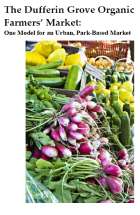
The Farmers' Market: vegetables, fruit, meat, fish, fowl, cheeses, breads, prepared foods, and specialty foods. Mainly organic.

For a listing of neighbourhood services, see our neighbourhood Marketplace page.
Toronto Farmers' Market Network website tfmn.ca
eat-local.ca is a recently launched Toronto project to connect people with local food sources.

Small Farm Canada promotes small-scale farming as a legitimate and viable endeavour.

Local Flavour Plus, Promoting the use of local food

London (England) Farmers' Markets
Farmers' Market (Main)
On this page:
About the Market | Latest Market News | Latest Food News | A Taste of the Market | Vendor Listing
Scanning...
See the Weekly Market Notes for a summary of the current week's offerings and events at the market.
Every Thursday 3:00-7:00 all year around
Outdoors around the rinkhouse in summer; in and around the rinkhouse in winter.
LocationClick here to view a map. Dufferin Grove Park rink house (875 Dufferin, S of Bloor), across from the Dufferin Mall. The rink house is in the northwest corner of the park, just off Dufferin. The closest subway stop is Dufferin Station (one block north). The Dufferin buses, both northbound and southbound, stop every three minutes right outside the rink house. ContactPhone: 416-392-0913 | email market@dufferinpark.ca Parkingposted February 25, 2007 You are very likely to get a ticket if you park illegally on Dufferin Park Ave., the little street leading into the park. Please obey the signs. Just a short walk away, across from St. Mary's High School on the north side of the park, there are special signs allowing parking on Thursdays for market hours. Please use those spots or other legal ones in the area. See satellite image. |
Map of FarmsSee our map of farms that come to the Dufferin Grove Farmers' Market. Email SubscriptionAnyone who wants to be on the weekly market notes e-mail list can subscribe by filling in the form (very simple). For some views of the market, see the Berman Photo Gallery , Pinkus Gallery. See the Toronto Farmers' Market Network website: tfmn.ca |
posted August 5, 2011
Farmers' Costs to Attend Toronto Markets
Vendor sales can range from $100/market for small-scale city-based vendors to several thousand per day for larger produce farms at peak season. In general, it is not considered economically viable for a farmer to come into the city for sales of less than $1,000, but many farmers have made investments in developing customer bases at small or new markets in Toronto where sales are lower, counting on longer-term success. While higher sales numbers can sound like a lot of profit, here are some things to bear in mind:
For produce farms, production costs (seeds, fertilizers and soil amendments (organic or conventional), irrigation equipment, machinery & repairs, temperature-controlled storage/washing/packing facilities, insurance, interest on farm loans, on-farm labour for cultivating, planting, weeding, harvesting, etc.) make up about 70% of the final price of produce at market.
For meat farms, sales volume is generally lower than for produce, and production costs are somewhat different, for example: a year of labour, fencing, shelter, veterinary and feed costs to raise calves to maturity, shipping and butchering costs ($45/animal plus approximately .45/lb to cut and wrap), staff to stay behind feeding animals. In the end, the total is again about 70% of the retail price at market.
So, for each $1,000 in sales, a farmer has $300 to cover all 'going-to-market' costs. These include:
1) Time (not including harvest, washing and packing in crates): in addition to market hours, 1.5 to two hours loading and unloading the truck on-farm, on average two hours travel at each end, plus 1.5 setup and .5 cleanup at the market, so a 4 hour market takes approximately 12 hours labour for two or more people. (Estimating the cost to the farm of having the farmer absent at peak season is harder.)
2) Gas and vehicle wear & tear: current estimates for a truck are .75-$1/km travelled, so for even the closest farms, over $100/market in travel round-trip. For farmers coming in from Niagara/Prince Edward County and other areas farther from Toronto, costs are substantially higher.
3) Equipment and supplies: tents, tables, signs, weigh scales, hand trucks, other display equipment, coolers and ice if needed, baskets, bags
4) Fees: markets charge about $25/week in table fees (or sometimes more) to each vendor to cover insurance, permit fees, some promotion, at-market equipment and manager/support staff time. Most farms also pay an extra premium on their own insurance to cover them at market.
Markets typically run for about 22 weeks, though some continue through the winter, with lower sales volume. Whatever the farmer earns at peak season must cover their expenses for much longer, and provide a buffer against crop failures; as well, for every top-notch day (eg/ peak of strawberry season) there will be slower ones, including days when inclement weather results in poor customer turnout but expenses must still be covered.
Why do they come? Farmers may work out an overall plan (participating in two markets in different parts of the city by dropping product and family/staff at one and attending the other, balancing production for a CSA (weekly box share program) with sales at markets, using direct sales as an alternative to the collapse in opportunity that occurred following mad-cow fears, combining deliveries to stores or restaurants with a trip to market...) that helps to reduce the risks and makes attending markets more viable. They also value the direct feedback, interaction and promotional value of markets. However, after calculating their expenses, it is easy to see that farmers must manage all aspects of their operations expertly to make a profit, and any trend towards higher costs would make it impossible to earn a living.
Toronto Farmers' Market Network, August 2011
From Lorenz Eppinger, Greenfields Organic Farm: Please send to your federal MP and pass on to others before Feb 8.
(This letter came from Arnold Taylor, President of the Saskatchewan Organic Directorate. He has been a major supporter of two Saskatchewan farmers' plight against the major corporation Monsanto.)
Dear
I strongly urge you to vote in favour of Bill C-474, an Act respecting the Seeds Regulations (analysis of potential harm) on February 9, 2011 and to speak during the debate on the bill on February 8, 2011. The text of the bill is as follows:
An Act respecting the Seeds Regulations (analysis of potential harm) Her Majesty, by and with the advice and consent of the Senate and House of Commons of Canada, enacts as follows:
1. This Act may be cited as the Seeds Regulations Act.
2. The Governor in Council shall, within 60 days after this Act comes into force, amend the Seeds Regulations to require that an analysis of potential harm to export markets be conducted before the sale of any new genetically engineered seed is permitted.
Bill C-474 is needed in order to protect all farmers, organic and non-organic alike, from the market impacts of genetically engineered crops. Had Bill C-474 been in place prior to the release of genetically engineered canola, we might still be able to grow certified organic canola on the Prairies, and European’s might still be purchasing Canadian canola and canola meal. All flax farmers might have been spared the millions of dollars of losses caused by the GE Triffid flax contamination crisis. Canadian alfalfa growers are very concerned about losing their best export markets as a result of the contamination that would surely happen if GE alfalfa is approved for sale in Canada, as it recently was in the USA. Market losses that would result from contamination if GE wheat were introduced would be in the billions of dollars. Future genetically engineered crops are predicted to contain industrial traits for biofuel feedstocks and drugs for pharmaceutical crops. Contamination of our food plants with these traits would most certainly damage, or even destroy markets for Canadian food crops.
Canadian farmers should be protected from market impacts of GE contamination of their fields and farms so they can contribute to providing the kind of wholesome, non-genetically engineered food that the public at home and in our export markets are increasingly demanding.
Please stand with Canadian farmers and consumers and support this important bill.
Sincerely,
During the week leading up to Foodstock, I'll admit that my resolve to attend was wavering. 20,000 people, really?? Would it be a freezing cold mudbath? Would there be a hopeless snarl of cars trying to get in? Should I just send along a donation and spend a cozy Sunday at home? Curiosity, concern for the cause, and a sense that something really big might be happening with this event won out, so Sunday morning my husband Jim and I picked up Dufferin bakers Leslie, Heidrun and Jenny and headed up the side roads. The trip went smoothly until a few kilometres from the hosting farms, at which point we slowed to about walking pace for nearly an hour.
Uh oh. A few cars bailed out, likely containing drivers caught by chance and wondering what on earth was going on. Then we climbed the last hill onto a broad plain and saw inching lines of attendees converging from every direction. Wow, much more inspiring than your average traffic jam! When we made it to a parking field that still had room, swarms of smiling volunteers directed us in.
posted on August 27, 2011
By: KATIE ZEZIMA
Published: August 20, 2011
Source: The New York TimesFLORENCE, Mass. - John Spineti started selling plump tomatoes and shiny squash at farmers' markets in the early 1970s and saw his profits boom as markets became more popular. But just as farmers' markets have become mainstream, Mr. Spineti said business has gone bust. Farmers in pockets of the country say the number of farmers' markets has outstripped demand, a consequence of a clamor for markets that are closer to customers and communities that want multiple markets.
on June 20, 2011
http://www.homemakers.com/blog/ecologic/tag/donna-tranquada/
Here's a really informative video with farmers: http://www.youtube.com/watch?v=I8ZkwK22hqIWhat can you do to stop it? Write letters of objection to the province of Ontario. Please demand an Environmental Assessment. Ask others to join you. The deadline is July 11, 2011. You can write to these MPPs to voice your views:
dmcguinty.mpp@liberal.ola.org Premier Dalton McGuinty
sylvia.jones@pc.ola.org Dufferin MPP
jwilkinson.mpp.co@liberal.ola.org John Wilkinson, Minister of the Enviroment
ljeffrey.mpp@liberal.ola.org Linda Jeffrey, Minister of Natural Resources
Here's a link to a recent article from the Orangeville paper that gives some sense of recent developments:
http://www.citizen.on.ca/news/2011-06-02/Front_Page/NDACT_heightens_quarry_siege.html
and here's a website with lots more detail: http://stopthemelancthonquarry.ca/
posted on May 28, 2011
By: JESSICA LEEDER
Published: May. 13, 2011
Source: Globe and Mail“From his post as director of food services at the University of Toronto's St. George campus, one innovative, local-loving chef is upsetting the status quo.
Jaco Lokker, who also oversees Chestnut Residence, is in charge of feeding more than 1,000 students three (or four or five, depending on appetites) meals a day for 32 weeks of the year. Under the constraints of the student meal plan, that means putting out 13,000 plates of food a week at a cost of about $3 each. That hasn't stopped him from converting 65 per cent of the food that passed through his kitchen last year to local fare and bringing farmers into cafeterias to trumpet it. That's more than a million dollars' worth of Ontario food, including all-organic Harmony milk, potatoes and Norfolk county apples.”
posted on April 25, 2011
Future of Farming in Canada:
1. How does your party’s platform address the shrinking number and
growing size of farms in Canada?
2. Canada doesn’t have a national food policy. Is a National Food
Policy a priority for your party?
3. Protecting farmland from development pressures has never been more
important than today… what steps will your party take to both protect
farmland and the ability for people to farm that land?
4. ON farmers have had to contend with free and open trade with the US
without the benefit of a US-style Farm Bill for support. It leaves
Ontario farmers at the mercy of the subsidized competition to the
South. Does your party support either a) creating a similar Farm Bill
or b) challenging the US Farm Bill at the WTO?
Climate Change:
1. It has been suggested that “real”, economically viable farms must
be at least $250,000 in sales annually- yet many organic farms are
more profitable with smaller gross income than that- what approaches
to agriculture are supported by your party’s platform?
2. Organic agriculture provides 30-50% greater water retention in
soil, reduces on-farm energy use between 20-60%, does not rely on
synthetic fertilizers, pesticides, or herbicides. What would your
party do to support greater adoption of organic farming as a climate
change mitigation strategy?
3. Seeds are a big issue for agriculture. Our pride and joy
internationally is Canola- bred through public research dollars.
Traditional seed breeding in the face of climate change is ever more
important. Today, we have no national seed bank, and our traditional
breeding programs have been gutted in favour of funding trans-gene
research. Do you support increasing public investment in a seed bank
and in seed stock development?
Organic Regulation:
1. Canada adopted our Organic Standards in 2009- yet today we have no
secure funding for maintenance and upkeep of this federal standard,
nor any funding for the work of the committees that do the
interpretation work. Without funding, our internationally recognized
standard is at risk: what would your party do to ensure long term,
stable funding for maintenance and upkeep of our hard won organic
standards?
2. While we’ve had an organic standard nationally since 2009, there
has been no promotional or educational campaign from the federal
government to promote the logo or educate Canadians on what the logo
means. Would your party invest in this promotion?
GMOs:
1. When the election was called, the Standing Committee on Agriculture
was about to vote on a GE Alfalfa moratorium: what is your party’s
position on a GE Alfalfa Moratorium?
2. Depending on the study, between 75 and 85% of Canadians want GMO
foods labeled: what is your party’s position on GMO labeling and why?
3. Organic farming techniques are increasingly being adopted or, more
rightly, returned to the broader farming landscape. Would your party
support permanent funding for public research on organic agricultural
techniques?
Farm and Food Infrastructure:
1. Local food is not a trend: it is a shift, says Sandy Houston of the
Metcalf Foundation. Yet to have local food year round, Canada needs to
heavily invest in and update our processing sector, as well as our
post-harvest handling and storage infrastructure. What is your party`s
policy on supporting investment in food processing?
2. Abattoirs are closing in Ontario at an alarming rate. The
regulations in place favour consolidation, not diversity, in
processing. Yet these regulations did not prevent the Maple Leaf
deaths . Other jurisdictions have regulations for micro and small
scale processing that is scale appropriate. What is your party’s
position on appropriate regulations for local, sustainably produced
processed food?
posted on April 20, 2011
By:' Carey Gillam
Published: 30-Mar-11
Source: ReutersA consortium of U.S. organic farmers and seed dealers filed suit against global seed giant Monsanto Co. on Tuesday, in a move to protect themselves from what they see as a growing threat in the company's arsenal of genetically modified crops.
The Public Patent Foundation (PUBPAT) filed the suit on behalf of more than 50 organizations challenging the chemical giant's patents on its genetically modified seeds. The group is seeking a ruling that would prohibit Monsanto from suing the farmers or dealers if their organic seed becomes contaminated with Monsanto's patented biotech seed germplasm. Monsanto is known for its zealous defense of its patents on a range of genetically altered crops. Its patented "Roundup Ready" soybeans, corn and cotton are favorites of U.S. farmers because of their ability to withstand herbicide treatments. Read more >>
posted on March 30, 2011
Ottawa, March 30, 2011 Canadian Organic Growers (COG), Canada’s largest organic farming organization has joined 59 other farming associations, seed companies and farmers in a legal action against Monsanto to challenge the chemical giant’s patents on transgenic (genetically modified) seed.
In a law suit filed Tuesday, the Public Patent Foundation (PUBPAT), a Manhattan-based public interest law association, asks the court to consider whether Monsanto has the right to sue farmers for patent infringement if Monsanto's genetically modified seed lands on their farm. Dan Ravicher, PUBPAT’s Executive Director, said “It seems quite perverse that an organic farmer whose land is contaminated by transgenic seed could be accused of patent infringement, but Monsanto has made such accusations before and is notorious for having sued hundreds of farmers for patent infringement, so we had to act to protect the interests of our clients.”
One of the goals of the suit is to demonstrate that the biotechnology patents issued to Monsanto, the manufacturer of DDT, Agent Orange, PCBs and a host of other toxins, are not in the public interest. In 1817, U.S. Justice Story wrote that to be patentable, an invention must not be “injurious to the well-being, good policy, or sound morals of society,” and “a new invention to poison people ... is not a patentable invention.”
COG member and organic farmer Arnold Taylor said “I’m thrilled that Canadian Organic Growers and other farm organizations are not afraid to stand up to the most dominant chemical company on the planet to defend the rights of farmers. Genetically modified seeds threaten the diversity of our seed supply, farmers’ rights to save seed and jeopardize the livelihoods of farmers who could lose access to international markets.”
According to Laura Telford, National Director of Canadian Organic Growers, “Organic standards place the responsibility to produce crops free of genetic contamination on the shoulders of organic farmers. Farmers are required to take appropriate measures to ensure that their crops are not subject to contamination from neighbouring fields. With the proliferation of patents for new transgenic crops from Monsanto, including most recently, a patent for Roundup Ready herbicide tolerant alfalfa, farmers’ ability to grow organic crops is becoming increasingly difficult”.
The full legal complaint is available at:
www.pubpat.org/assets/files/seed/OSGATA-v-Monsanto-Complaint.pdf
For more information, contact: Laura Telford, National Director,Canadian Organic Growers
613 216-0742
613 298-8848 (cell)
laura@cog.ca www.cog.ca
Dan Ravicher
Executive Director
Public Patent Foundation
Benjamin N. Cardozo School of Law
55 Fifth Ave., New York, NY 10003
212 461-1902
ravicher@pubpat.org www.pubpat.org
posted on March 25, 2011
By: Kathleen Purvis
Published: March 24, 2011
Source: I’ll BiteDean Cliver never expected to become famous as the man who saved wooden cutting boards. But that's science for you - you never know where it's going to take you.
Working on this week's story about kitchen cleaning gave me an excuse to call lots of scientists. I always love those guys: People who spend their lives studying very small things that make you very sick are always a blast. Seriously. For instance, Doug Powell of Kansas State University founded a Web site called The Barf Blog . It's fascinating reading, if you have a strong stomach.
Powell kept telling me the trick to understanding how to keep your kitchen safe is "be the bug -- think like the bug." Hard to do for the average person, but a fun game for a rainy Saturday night.
I also talked to Cliver, a microbiologist at the University of California-Davis who is a legend in the food-safety world. Cliver is 76, but he's still studying the involvement of viruses in foodborne illness. Read more >>
posted August 5, 2011
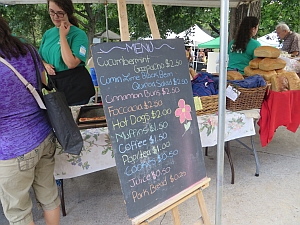
Hungry? There's always a bit of food to try or snack on at the market. Menus vary according to the season, but here are some examples:

See the Tasting Fair Photo Gallery.
Akiwenzie's Fish: Andrew and Natasha Akiwenzie bring fresh & Smoked Georgian Bay Fish. They have a blog to keep you up to date on fishing conditions and what's new: akiwenziesfish.blogspot.com Contact: Email: akiwenziefish@gmail.com
Alli's: Organic breads include Sweet Potato, 5-Grain, Potato-Rosemary and Foccacia. Gluten-free products and small edibles, including Jalapeno Screamers, are also available. See Alli's vendor notebook entry Contact: Phone: 416-651-2929
Bees Universe : John and Irina Alecu keep bees in 10 different yards close to wild flower fields and conservation areas, between Toronto and Barrie. They sell honey, honey comb, bee pollen, propolis (raw and tincture), fresh frozen royal jelly, beeswax candles and also live bees. See the vendor notebook entry
Contact: Phone: 416-819-2337 | Email: office@beesuniverse.com | Website: www.beesuniverse.com
Beretta Organics (certified organic): Mike and Cynthia Beretta farm in King township, an hour north of Toronto. They bring beef, pork, turkey, chicken and deli items to the market. Pre-orders are accepted up to 1:00 Tuesday. See the vendor notebook entry
Contact: Phone: 416-674-5609 | Website: www.berettaorganics.com | This month's order form: Order Form
Bestbaa Farm: Peter and Nicole Bzikot offer Plain Yogourt, Maple Yogourt, Feta, Ramembert, Brebettes, Eweda & other cheeses, of course all from sheep milk. Lamb, too. Best Baa will also be scooping many flavours of sheep's milk ice cream throughout the summer.
Contact: Phone: 519-848-5694 | Email: Nicole at nicole.bestbaa@hotmail.com
ChocoSol : Michael Sacco and Mathieu bring chocolate foods, coffee and more: "ChocoSol is a Learning Community and Social Enterprise rooted in horizontal trading relationships between Southern Ontario and Southern Mexico. We make high quality organic dark chocolate foods fused with local flavours and initiatives. Our chocolate is stone ground fresh, gluten-free and nut-free."
Contact: Phone: 416-923-6675 | Website: www.chocosoltraders.com | Email: Michael Sacco at chocosol01@yahoo.ca
Clement's Crepes : Tim Clément's crépes are hand-spun with organic whole wheat flour, organic free-range eggs, whole milk, sea salt, and ingredients from the market farmers. Both sweet and savoury crépes are served piping hot, with ever-changing seasonal fruit and vegetable fillings, and now there are burritos, too.
Contact: Email: Tim Clement of Clement's Crepes tmaclement@gmail.com
Country Meadows Gardens (certified organic): Angelos Kapelaris grows heirloom tomatoes, keeps laying hens, presses goat cheese, and brings olives and oil from his family's farm in Greece. See the vendor notebook entry and a Picture Gallery >>
Contact: Phone: 905-478-1201 | Website: www.countrymeadowsorganics.com
deFloured: Krista Tobias and Chris Brown make 100% gluten-free galettes, loaves, quiches, cookies and brownies that are delicious enough for everyone, featuring a seasonal selection of local and mainly organic ingredients. Contact: deFloured@gmail.com
Dufferin Grove Bakers community oven bread: (not certified: all flour and seeds and grains are certified organic but the oven is not certified). Breads include: grapeskin-sourdough, rye sourdough, Italian rosemary, Italian olive, artisan 6-grain, artisan pumpkinseed-sesame, raisin and others, along with cinnamon buns and pizzas with market toppings.
Contact: dufferinpark@dufferinpark.ca
Earthly Paradise:(Fall and Winter) Each plant used in earthly Paradise's products is organically grown by us or sourced from ethical companies that share our vision of a beautiful and bountiful planet. Nourish your skin and your spirit with our products: Creams, Salves, Products for the Face, Teas. Contact Colette Murphy.
Contact: Phone: 416-504-1653 | Email: grow@uharvest.ca | Website: www.earthlyparadise.ca
Evelyn's Crackers: Dawn Woodward and Ed Rek bring savoury artisanal crackers, named in honour of their daughter, Evelyn, and made with local, organic and fair trade ingredients. They also supply the market with Ontario flour from CIPM farm near Stirling. Contact: Phone: 647-448-0731 | Email: evelynscrackers@gmail.com | Website: www.evelynscrackers.com
Feast of Fields Farm: near Jordan ON, Demeter-certified since 1996, and now also Local Flavour Plus certified. Laura Sabourin grows grapes, pears, peaches, raspberries, and blackberries. She also makes grape juice and preserves.
Contact: Website: www.feast-of-fields.ca
Fish Shak: Alli Harris makes wild fish sandwiches and rotis, using many of farmer Ted Thorpe's vegetables throughout the summer. He also blends fresh and healthy juices and other cold drinks.
Contact: Phone: 647-884-7425
Forbes Wild Foods: (natural wild foods from Canadian sources) -- Jonathan Forbes offers dried wild mushrooms, wild rice, maple sugar, preserved wild foods, jams, mustards, chestnut flour, and more.
Contact: Website: www.wildfoods.ca
Fun Guy Farms: Bruno Pretti and Paula Vopni are mushroom growers. They have many varieties of fresh mushrooms including shiitake and oyster, as well as mushroom pesto, crackers and Kombucha beverage. All their mushrooms grow on or are cultivated on wood, never on composted animal manures. Contact: Phone: 416-402-9755/416-963-5521 | Email:office@mycosource.com | Website: www.mycosource.com.
Greenfields Farms (certified organic): Lorenz and Adrian Eppinger have a farm near Guelph which includes a 25-acre market garden. The farm also includes ecologically protected areas and is Bullfrog Powered. In addition to their own produce, Greenfields works with Pfennings, a local, farm-based distributor, to supply the winter market with a selection of imports and produce from other regional farms. See the vendor notebook entry
Contact: To place a special order, Email: greenfields@interhop.net. | Website: www.greenfieldsfarm.ca
Growing Spaces is owned and operated by Blythe Weber and Adam Smith. Blythe grew up farming with her family near Ayton. The farm is a mixed operation, currently in transition to organic certification. They grow vegetables and fruits on the farm to make the many varieties of chutneys, pickles, jams and other preserves which they bring to the market. Blythe and Adam also help urban dwellers create edible gardens in Toronto.
Contact: Email:info@growingspaces.ca. | Website: www.growingspaces.ca
Kind Organics: Tamas Dombi, Sandra Dombi and Amber Malek are partners in the co-creation of Kind Organics, originally formed in the year 1999 as a Demeter Certified Bio-Dynamic/Organic Farm in King Township. They are now located 40 minutes north of Toronto in the Holland Marsh. Kind Organics uses organic farming techniques only and is moving towards bio-dynamic farming. They grow Salad Blends, Sprouts, Wheat Grass, Micro Greens, Fine Culinary Herbs, Edible Flowers and various kinds of Baby Greens. Contact: Phone: 416-992-1444 | Email:kindorganics@gmail.com | Website and blog signup: www.kindorganics.ca
(Colette) Murphy: Spring and Summer, see Urban Harvest. Fall and Winter, see Earthly Paradise
Contact: Phone: 416-504-1653 | Email: earthlyparadise@ca.inter.net | Websites: www.uharvest.ca, www.earthlyparadise.ca.
Niagara Lavender Farms: Debbie Wiecha is a third-generation fruit farmer who produces a wide variety of tender tree fruits, berries, and lavender. Most crops are certified organic; some peaches are low-spray. Contact: Phone: 905-468-7482 | Email: mailto:niagaralavender@hotmail.com
Pine River Organic Farm: Bob Felhazi has a large asparagus planting, greenhouses, raspberries, and many varieties of certified organic vegetables on his farm near Alliston. His helper Helga represents him at the market. Contact: Phone: 705-424-0917
Plan B Organics: in West Flamborough, ON. Melanie Golba and brothers Alvaro and Rodrigo Venturelli have a fifty-acre farm of which 18 -20 acres are used to grow mixed organic vegetables to supply their CSA and markets. Another part of their land is a reforestation project. See the vendor notebook entry
Contact: Phone: 905-659-2572 | Email: planbof@execulink.com | Website: www.planborganicfarms.ca
Sosnickis Organic Produce, Waterford, ON (south of Brantford): Ben and Jessie Sosnicki grow certified organic wheat, cabbages, corn, potatoes, tomatoes, and more. Jessie's family is Ukrainian and Ben's is Polish, so they also sell sauerkraut, perogies, cabbage rolls, and tomato sauce, made with their certified produce. Visit their blog for regular news from the farm: sosnickiorganicproduce.blogspot.com
See the vendor notebook entry | See the picture gallery from June, 2004>> | See the picture gallery from September, 2004>>
Contact: Phone: 519-443-5903 | Email: jb@sosnickiorganics.com | Website: www.sosnickiorganics.com
Thorpe's Organic Produce: near Millgrove, ON. Ted Thorpe, a fourth-generation Ontario vegetable-farmer, has a 32 acre-farm, of which 20 acres is a market garden. He grows all kinds of vegetables and herbs.
Contact: Phone: 905-689-2114.
Under Ground Organics: Shane Eby, Julia Hitchcock and Dan Riegler grow many herbs and over 100 varieties of cutflowers, from spectacular spring tulips through lupines, foxgloves, sunflowers and others. Great vegetables, too!
See also the photo gallery from September 2008 >>
Contact: Phone: 905-659-6267 | Email: ugo@gofairtrade.net | Website: www.undergroundorganics.net
Urban Harvest:(Spring and Summer) Urban Harvest is dedicated to providing its customers with seedlings and garden supplies that promote ecological diversity and preserve the health of our planet. Our plant seeds and garden supplies are specially chosen for their qualities by seasoned urban gardeners. All of our seedlings are grown in or near the greater Toronto area to support our local economy. Contact Colette Murphy.
Contact: Phone: 416-504-1653 | Email: grow@uharvest.ca | Website: www.uharvest.ca
Ying Ying Soy Food: Ming and Christy make many delicious varieties of tofu, using traditional, artisanal methods, and non-GMO soy organically grown by Ontario farmer Marcus Koenig. If you've only eaten supermarket tofu, come taste the difference. Contact: Phone: 905-847-5592 | Website: www.yingyingsoyfood.ca