


Pages in this Folder:

Related Folders:
See also Department Site Map
This website was developed in 2001 thanks to a grant from the Toronto Parks and Trees Foundation.

Notice: This web site is an information post and a forum for the community that uses the park, and to some degree for the surrounding neighbourhood. The editor of the web site reserves the right to post parts or all of any letters sent to the web site. If you do not want your letter posted, please let us know when you e-mail us, and we won't post it.
Comments?
For the basics, see
- Website & Privacy Policies
- How To Get Involved
- The Role of the Park
Search options:
Department Site Map

Jutta Mason, Editor
Masthead
Dufferin Grove Park News Website and Newsletter
Editor:
Jutta Mason
Illustrations:
Jane LowBeer
E-mail:
editor@dufferinpark.ca
Web address:
www.dufferinpark.ca
Park phone:
416 392-0913
Street address:
875 Dufferin Street
Custodians:
 Printer friendly version
Editor (Main)
Printer friendly version
Editor (Main)
EDITORIALS
2022 Dufferin Grove Park News
2021 Dufferin Grove Park News (ARCHIVE)
Covid rules
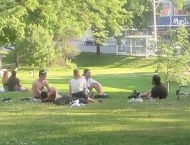
picnics limited to 5 distanced people
On April 17, 2021, under the province's stay-at-home order, outdoor activities in the park were limited. Playgrounds were not barriered off, and the police said they would do no random stops. However, the solicitor general said that police will stop and question anyone engaged in prohibited activities. read more
Despite these restrictions, here is an odd plot twist: from April 7 2021 onward, Ontario has consistently had more intensive care patients (per 100,000 population) for the third wave of covid than Sweden has: link. The park activities that are prohibited here in Ontario are encouraged in Sweden. We have first-person reports from a pen pal in Sweden

The playground
The sandpit (time for a fundraiser?)
The sandpit was put into the park in 1993. A bulldozer came and dug a hole about forty by twenty feet and two feet deep, and loaded the dark soil into a couple of Mack trucks, which took it away. A 15-inch layer of gravel was spread across the hole, and then the trucks returned with loads of fine, damp sand, and dumped it on top of the gravel bed. Read more
Construction project, northwest corner
The construction fence went up April 2, and the Pellegrino construction crew has been working steadily ever since -- first dismantling the inside of the rink house and then removing the rink. The crew are remarkably friendly and helped the gardeners to get a few additional things out before they got started. read more
Community gardens
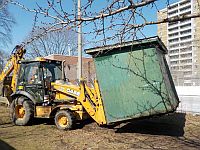
moving the garden shed
From garden coordinator Skylar Hill-Jackson (contact: gardens@dufferinpark.ca):
At the end of March, city workers made a temporary two-year community garden area to replace the existing gardens (now fenced off because of the rink reconstruction). Since then, garden co-op volunteers have moved a lot of plants. Everyone is welcome to join in the gardening! read more
July 2021 garden sessions:
Tuesdays 4-6pm
Sundays 2-4pm
The garden co-op is a volunteer drop-in program. Please bring garden gloves and water to drink.
Indigenous sacred herbs garden
Food in the park
The cob kitchen
The cob kitchen was built with the help of hundreds of volunteers aged 6 to 65, in 2005. Georgie Donais had the idea, got people together, and was the every-day hands-on leader who made it happen. The city plumbers and electricians plumbed and wired it. After 11 years of all kinds of weather, this outdoor kitchen is still solid.
The rink kitchen is gutted, and its replacement will take a few years to build. But the cob kitchen could be the key to a post-covid revival of the park's food programs, this summer. read more
The community bake oven

The smaller bake oven has been moved to a new place, down by the playground. read more
The farmers' market
Many of the city's farmers' markets are operating, but at a much reduced capacity because of public health rules, often with large lineups. Dufferin Grove market is still operating virtually, out of St.Anne's Church at 270 Gladstone. Market manager Anne Freeman says the plan is to continue that way for now and possibly until the rink house construction is finished. read more
Park cookies: A neighbour who used to enjoy the Friday Night suppers wrote to ask for the park cookies recipe, so she could make them with her children -- since there's no telling when the suppers will return. This recipe was introduced to park staff by the Canadian Living test kitchen cook, in 1996. read more
...to be continued.....
Archive (pre-lockdown)
2019
May 27, 2019: The fate of the NW corner trees
April 11, 2019: Boilerplate and red herrings
Feb.6 meeting Follow-up posts about the "Northwest Corner Revitalization Project"
1. Capital Projects staff’s BIG Problem: covering their payroll
Lots of people have noticed that even though city staff hold many public consultations for new public building projects nowadays, what gets built at the end may not closely resemble what people asked for. When all the questionnaires and stickies on plan boards have been collated, the projects still often look a lot like what Capital Projects staff originally put into the city budget. Here’s one reason why --
Not long after the four different cities that make up the current Corporation of the City of Toronto were first stitched together in 1997, a park supervisor told me something strange. read more.
2018
“What if”: personal injury lawsuits at Dufferin Grove in 25 years – only three in total
Excerpt from the July 2018 newsletter, revised and updated March 19, 2019
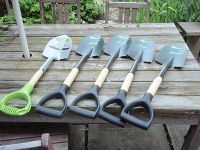
Dufferin Grove sandpit shovels
In public spaces, it sometimes seems like there’s more effort put into stopping good things from happening – “what if there is a lawsuit?” – than into helping to make good things happen. For instance, one of the recent recreation program staff at Dufferin Grove Park was not only worried about the use of the metal shovels at the adventure playground, but even about the kids being hurt by the water coming from the tap. He says he’s seen small children being “severely splashed” when the tap flow is strong enough to create the stream that turns children into little engineers all the way down to the lane. Someone could be injured and then there’s a lawsuit.
Since CELOS is a research organization, we decided to find out how serious the problem of injury lawsuits against the city really is. The sandpit has been going for 25 years now, and there were always metal shovels. The water tap was added about 20 years ago, after the kids lobbied hard for water and kept moving the garden hoses over to the sandpit.
It costs only $5 to make a freedom of information request, so in early May, CELOS asked for “a complete, detailed list of every legal claim made against the City of Toronto for any event occurring at Dufferin Grove Park since 1993.”
On June 22 we got the answer. It said that there have been only three injury claims against Dufferin Grove Park over the past 25 years, all apparently resulting in a payout.
In 2001 there was a claim for an incident on March 31 described as trip and fall on raised interlocking brick in path: "The trip ledge was created when City Parks Trucks were sodding on either side of interlocking brick path.The injury was a fractured left wrist."
The settlement was $36,250, plus almost $13,000 for the city's legal costs.
In 2011, there was a claim for Feb.22 when ''Dog ran out on rink and claimant fell over dog injuring his back." Cost to the city: $799.20.
Later, in September of 2016, there was a claim for "CLAIMANT SLIPPED AND FELL IN DUFFERIN GROVE PARK....tripped over parking curb, Broken left collar bone." Cost to the city: $1078.
Conclusion: the cost of lawsuits at Dufferin Grove Park - not much
During the past 25 years of liveliness, although some kids must have broken their arms falling off the monkey bars - some soccer players must have turned their ankles on the playing field - some shinny hockey players must have crashed into each other on the ice - park cookies and mini-pizzas must have disagreed with somebody’s digestion - thousands of park campfires flickered close to people’s clothing - youth did gravity-defying stunts on their DIY skateboard rink pad – yet during all that time the city reports only 3 physical injury claims, and none for any of those good things that happened in the park. Total amount for these claims paid out over 25 years: $51,029.51.
So there’s good news. It seems that people who come to the park are NOT very litigious. That should mean the shovels and the water can stay, and the campfires and musicians and the shinny hockey (without mandatory helmets) too.
2017
Dufferin Grove food costs
I've had a number of comments about the August newsletter -- mainly people saying they liked the fact that a new one has come out but that they only had time to skim it. People are very busy. If a reader only has a minute to look, this Dufferin Grove food income graph in the newsletter is thought-provoking:
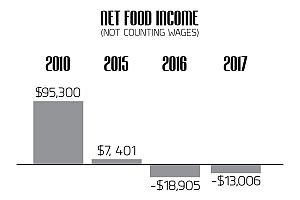
food sales don't even cover grocery costs
In other words, the food at the park no longer pays for itself, if I'm reading the city's book-keeping right. It appears that the food sales don't even cover the materials, and there is nothing left to pay the cooks. So the city subsidizes the food for park users by paying the cooks' wages out of the city's operating budget -- which can't be viable.
Jane Jacobs said| "The more that cities can make of their own ordinary people’s capacities for economic and social invention and experiment, the more useful and valuable cities become – not only for their own people but also for their nations."
Dufferin Grove is a poster child of the messy (and costly) results when managers squash the capacities of their "ordinary people" - in this case resourceful locally-oriented program staff. The policy jumble trumps good sense.
I'm told that Mayor John Tory advised the Bentway (Under-Gardiner) Park sponsors NOT to let the park be run by Parks and Rec because that department is "broken." Nice that the Bentway was able to detour into a Conservancy instead, but sooner or later our city councillors, including Councillor Bailao, need to address the problems that our taxes are funding, head-on.
2016
The governor-general's Caring Canadians Award is being changed to a medal...
...now to be called the Sovereign's Medal for Volunteers. Here's an excerpt from my story of getting the Caring Canadians Award in 2012:
....At the time the bureaucratic troubles that we had been experiencing for years at Dufferin Grove Park were intensifying. So I was not feeling even slightly like a Caring Canadian, more like an Exasperated Canadian. On the other hand, a teenage cousin of mine from Berlin was scheduled to arrive in March for a two-months’ stay, to practice her English. I had been racking my brains for ways to keep her busy, and a visit to the Governor General’s house in Ottawa seemed like a possible adventure. So I accepted with gratitude....

my cousin Sophia at Rideau Hall
...The hall was beautifully set up with many round tables laden with different kinds of delicious hors d’oeuvres, soups, sandwiches, salads, fruit, and little specialty pastries. At the centre of many tables there was a large flower arrangement. An enormous full-length portrait of a young Queen Victoria dominated the room. Waiters in black walked around with glasses of wine. People filled up their plates, and stood in little groups chatting and networking.
I met a nice woman I knew years ago in Toronto. She said she does data entry now in a federal office in Ottawa. She had come to the ceremony because, the afternoon before, a memo had gone out to government staff, urgently inviting anyone with time to come to some ceremony that might otherwise be seriously under-attended. They needed bodies in the seats, and in return the staff would get to eat a fine lunch at Rideau Hall, and maybe have a chance to chat with other government workers from other departments. So that explained it: most of the audience were from central casting, smiling and clapping for the ceremony. Just as we Caring Canadians were, maybe.
I found my cousin Sophia, and she said she had been kindly put in charge of some of the older guests, who had asked her about Berlin and helped her practice her English....
Read the whole story
2015
In five years of “harmonizing” Dufferin Grove Park with the rest of the city, the cost of running the park balloons to $750,000 a year. But it’s less fun
It’s been five years since the long-time recreation supervisor of this area, Tino Decastro, was removed. At the same time the informal partnership between city staff and CELOS wound down, and an entirely new staffing system was set up. Ten years of experimental collaboration between CELOS and city staff working together – on how to make a lively park – have been followed by five years of a different kind of experiment by city management. Now the results of that second experiment are in.
The cost of running Dufferin Grove, since its management was centralized, has ballooned. Freedom of Information requests show an increased cost of almost 40% over four years. In 2014, the most recent city financial report, it appears that the net operating cost was close to $750,000, up from about $550,000 in 2010. The math is outlined in the next three pages, and in even more detail on the financial pages of the celos.ca website.
Coincidentally, city government spent upwards of $71 million over the past 6 years to upgrade its financial reporting system (called SAP), saying it would be much more transparent and easy to track. The improvement is not easy to see. read more